Decommissioning of USS Caine
The Caine MutinyThe Decommissioning of USS Caine ends the ship’s service and Willie Keith’s command with a ceremony that makes routine wartime labor, rather than spectacular achievement, the measure of its importance. At Bayonne, with the ship stripped of its guns, ammunition, and fuel, Willie addresses a reduced crew, orders the flag lowered, and completes the transfer of the ship’s records and keys. His farewell insists that the Caine’s largely uncelebrated work counted, even as the ceremony confirms that the vessel itself is finished.
Background and wartime service
The ceremony follows a war in which the Caine’s work was extensive but rarely glamorous. The novel contrasts the broad historical view of early 1944, when the Allies’ position appeared increasingly strong, with the narrower experience of officers serving aboard an old ship at sea. In January, a vast fleet sailed from Hawaii toward Kwajalein; the Caine was one small vessel within a much larger operational formation. Its own service included long stretches of escort duty and routine fleet work, rather than a continuous sequence of major battles.
That distinction matters to Willie’s farewell. The Caine was supposed to be a minesweeper, but its actual duties ranged across the fleet’s less celebrated needs. Its crews endured repetitive watches, paperwork, and extended periods of escorting. A mine finally surfaced in the ship’s wake in the China Sea seventeen days before the war ended. Later, when destroyer-minesweepers in Buckner Bay were ordered to prepare for the Tokyo harbor sweep, the Caine was left out. Its pumps had been repaired, but a naval officer questioned whether the worn ship could safely make the journey, particularly during typhoon season. The missed operation sharpens the contrast between the fleet’s onward movement and the Caine’s declining readiness.
The ship’s eventual retirement also stands against the scale of wartime operations. Its service took place within a war that had included major turning points and vast fleet movements, yet the Caine’s contribution was chiefly the accumulation of ordinary tasks. Willie’s address does not claim that the ship was exceptional; it argues that the work assigned to ships like it was necessary all the same.
The ceremony at Bayonne
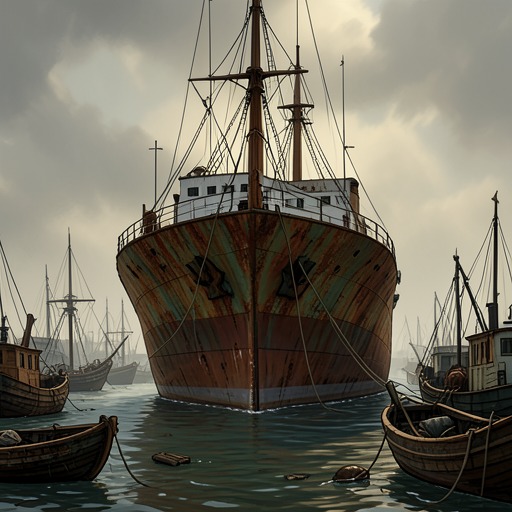
On the morning of October 27, the Caine had been tied up at a dock for three days. It was empty of guns, ammunition, and fuel, and the paperwork was complete. The decommissioning ceremony was due to begin in half an hour. Willie, in his cabin, read from a book while waiting; the occasion finds him at the threshold between command and civilian life, though the ceremony itself remains a formal naval procedure.
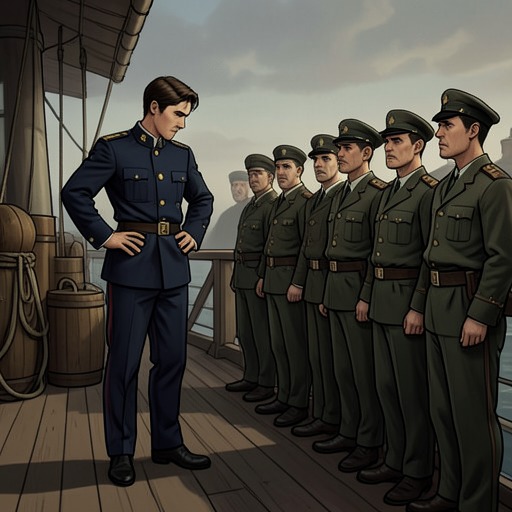
His executive officer reported that the ship’s company was at quarters. Willie went out to the forecastle, returned the crew’s mass salute, and faced ranks that seemed unfamiliar to him. Many of the men released under the Navy’s point system had already gone. Among the few familiar faces were Budge, Urban, and Winston; most of the remaining crew were newer personnel, including men drafted late in the war. The absence of former shipmates gives the ceremony a double sense of ending: the vessel is being retired, and the company that had made it a shared home has largely dispersed.
Willie had prepared a long, sentimental speech, but, facing the reduced crew, he found that he had nothing prepared that he could say. Instead, he read the decommissioning order in a strained voice. The formal announcement did not erase his attachment to the ship, but it made the ending official: the order, the assembled crew, and the emptied vessel turned a long service into a completed record.
Willie’s farewell and the lowering of the flag
After reading the order, Willie spoke of the Caine as a broken-down, obsolete ship that had steamed through four years of war. It had no unit citation, had achieved nothing spectacular, and had swept only six mines. Most of its work, he said, had been menial fleet duty, including hundreds of thousands of miles of escorting. He did not disguise the ship’s limitations or turn its record into a conventional tale of battlefield distinction.
Instead, Willie changed the scale by which that record should be judged. He told the crew that the hours spent aboard the Caine would later matter to them, because they had taken part in work the country needed. The ship’s service, in his account, was not superior to the war’s more conspicuous operations, but it belonged to the same collective effort. His closing claim, “Caine duty is the kind of duty that counts,” gives the farewell its central meaning: the dullness and modest scale of the work do not make it dispensable.
The order to lower the flag follows the speech. The executive officer brought Willie the remnant of the commission pennant, which he rolled up and kept. Willie also asked for the jack to be wrapped and brought to his cabin. These acts preserve pieces of the ship’s colors as personal and material remnants while the ceremony ends its official identity. After the men were dismissed, Willie handed over the keys and records, signed the last logs, and arranged for the wrapped jack to be mailed to Horrible’s parents.
Aftermath and significance
When the remaining chores were finished, Willie went down the abandoned gangplank without saluting: there were no colors left to salute and no officer of the deck. The Caine was now junk. The plainness of that departure completes the reversal from commissioned warship to discarded hull. The ceremony does not restore the ship or award it a belated distinction; it gives formal closure to a service whose value, Willie argues, lay in doing what had to be done.
The ending also marks Willie’s passage out of naval life. As the ship is decommissioned, he recognizes that his identity as a naval officer is receding, but that his former civilian self does not simply return unchanged. His farewell therefore closes more than a ship’s record: it brings his command to an end and leaves him between the wartime role that shaped him and the life awaiting him ashore.
The novel’s prefatory note makes clear that this is a fictional event, not a historical record of an actual USS Caine. It states that the ship and the events aboard it are imaginary, and that military details were altered to serve the story or avoid disclosing restricted information. Within that fiction, the decommissioning gives the book’s argument about ordinary naval service its final public expression: victory may be dated by major operations, but it also depended on ships whose work was repetitive, limited, and necessary.